



When the center becomes harder to feel
Recently I found myself wandering, feeling as a nomad stuck in the inbetween. I lost my spiritual teacher last year and had a hard time finding who I was without the sangha, without the teacher’s guidance, and began to question all the rituals and lessons I had learned.We had a classic guru-disciple type of relationship and as you can imagine I was heart-broken.
Maybe you’ve had a taste of this — not so much losing your teacher, but that familiar drifting that happens when life accumulates and the center becomes harder to feel. The practice is still there. The meditation, the breath, the text. But something grows a little distant within you, a little formal. Like you’re going through the motions of returning without quite arriving.
It’s a strange and difficult place to be. And in this last year, after all the emotions were shed, I found the nomadic existence to generate a sort of apathy within me. I slowly found myself building a wall to the practice. And yet as I built a wall, I simultaneously yearned to find my Self day after day.
And then, as it always does, the Gītā brought me home.
Not through a new insight or a deeper level of understanding. Through a verse I had read many times before, arriving differently. A small crack of recognition. And in that crack — the feeling I can only describe as remembering. Not learning something new, but returning to what was always already true with yet another layer of depth unraveled. A returning home to the deepest parts of the Self — and an even deeper connection with Śrī, that luminous, auspicious presence that the tradition teaches is always already here, waiting to be recognized.
This is what the Bhagavad Gītā does. Not once. Again and again, allowing you to gently unfold across a lifetime — when you open to it.
I came to yoga the way most Westerners do — through the body. But I had always been a seeker. Through art, through philosophy, through Buddhism and various contemplative traditions. All of these were vehicles, they were forms to try to bring me back to the same source – the eternal within me, the soul or as yogis call it the atman.
The mat opened the vehicle of my body. It created space for prana to move, for awareness to expand, for something long held to begin to soften and release. I remember the moment I had my first unravelling with yoga clearly — pigeon pose, an ordinary morning, not expecting anything. And then as I held it for a while my body gave way and unlocked ties that had been with me for well over 20 years…I sobbed. Not from pain but from recognition of my essential nature that came with releasing the karmic knots created by my body for protection. These feelings, these memories, these stories I had, had been locked inside me for years and once they released, a sense of freedom came.
Through years of practice, awareness expanded through me, and it brought me back — again and again — not to the mat, but to my life. To the unskillful decisions. To the places where I was performing instead of being, avoiding instead of acting, confusing comfort with Truth. The practice was a mirror. And slowly, through that reflection, I began to find my Self within those moments — and remember who I actually was.
This is what the Bhagavad Gītā has been for me ever since. Not a sacred text I study from a distance. A living mirror. A user’s manual to help me attain the purpose of life – moksha or liberation that is created when one comes in touch with the individualized soul and experiences it’s interconnection with universal consciousness.

The battlefield is always now
The Gītā opens on a battlefield. Arjuna — great warrior, prepared and skilled — freezes. He cannot lift his bow. He sees the faces of people he loves arrayed against him and is overcome by grief, confusion, and the desire to simply walk away from all of it. His teacher Krishna does not console him. He offers him something far more valuable: clarity. And the dialogue that follows are eighteen chapters of the most precise, compassionate, and demanding philosophy ever written.
The Core: You know who you are. Now act from that place.
What has struck me most deeply in sitting with this text over many years is how it never stops being relevant. Not because the world keeps presenting us with the same problems, but because we keep arriving at the same essential crossroads — the moment where we must choose between what is comfortable and what is true. Between the conditioned self and the witnessing Self. Between the costume and the One who wears it.
We are consistently being barraged with distractions that keep us acting from the heart and soul and yet something within us is always being nudged back toward our essential nature. All the time, a latent force is quietly trying to remind us what we are. Our senses turn outward, the noise accumulates, we drift — and the nudging continues. This is the grace of the Divine Mother that the Gītā speaks of. Not something we earn or manufacture. Something that meets our sincere effort and descends. All it takes is one small step, serving the Highest Self and Sri or cosmic auspiciousness starts to reveal itself.
Verse 2.40 carries this promise with extraordinary tenderness:
On this path effort never goes to waste, and there is no failure. Even a little effort toward spiritual awareness will yield protection from the greatest fear.
Even a little. Sincere, repeated turning toward what is true — this is enough to begin the return.

Sthitaprajña: the steady flame
What I have come to understand — and what the practice keeps teaching me — is that Self-realization is not a destination I approach by accumulating more knowledge, more discipline, more refinement of the vehicle. At a certain point the learning becomes a kind of hiding or grasping. A way of staying busy with the map instead of walking the terrain.
The real question the Gītā asks is simpler and more demanding than any technique:
How do you engage and what is the source that moves you?
In any given moment — with the person in front of you, with the decision that asks something of you, with the discomfort you would rather avoid — can you remember who you are – the Supreme Self, the Divine, the Great Spirit? Can you pause long enough to honor the consciousness that is moving through you, and allow grace to flow rather than forcing your personality’s own agenda through?
This is what the tradition calls living from the Supreme Self. Not a state we arrive at once and keep. A practice of return. Of remembering. Choosing, again and again, to act from the deepest place available to us in that moment — even when it costs us comfort, even when it asks us to release an identity we have grown fond of.
I have shed many of my own, I have worn many hats. As a youth I started out as a free flowing hippie, then later developed a hard exterior I built coming of age in New York, I had a working professional identity that I had to release when something truer called, in addition I have shifted perceptions of what it means to celebrate, to provide, to belong — all of it part of what the Gītā calls the lila, the great play of life, the wearing of costumes for roles we inhabit along the way. The teaching doesn’t ask us to judge these costumes. It asks us to know we are wearing them. And to keep asking, beneath each one: who am I? And can I act from my essential nature?
As students walking this path, you have already touched this ground.
Perhaps you have felt it in what modern psychology calls flow — that state of complete absorption where the sense of a separate self temporarily dissolves and something larger moves through you. Athletes know it. Artists know it. Musicians, dancers, mathematicians. A moment where effort becomes effortless, where you are not doing so much as becoming a vehicle for energy and creativity to move through.
In the yoga tradition, this is not an accident of peak performance. It is a glimpse of Sthitaprajña — the steady-minded one, or illumined awareness. The one whose wisdom is unwavering. Whose inner ground remains unshaken by praise or criticism, gain or loss, expansion or contraction. Steady, luminous, not diminished by outcomes, not inflated by praise — this is the portrait Krishna paints of the one who has learned to act from the Supreme Self.
Those of you that teach may have stood in front of a room and felt something move through you that was larger than technique. The moments where teaching became transmission, where the room shifted in ways you didn’t plan. You know the difference between delivering information and being a channel for something that wants to arrive. The Gītā has a name for what you touched in those moments. It is the same awareness the whole text is pointing toward — Sthitaprajña, the steady flame that burns without flickering regardless of what the wind does.
You also know how quickly that ground can be lost. How the accumulation of daily life, the weight of responsibility, the pull of a thousand small attachments can quietly move us away from center without our even noticing. Until one day we find ourselves going through the motions — present in form, absent in depth.
This is not failure. This is the path. The Gītā is not a teaching for those who have already arrived. It is a teaching for those who keep returning.
Verse 2.40 does not say if you wander, it will protect you. It says effort on this path is never wasted. The returning itself is the practice. Every time we choose to come back — to the breath, to the question, to the text, to the community — something accumulates that does not disappear. A deepening. A steadiness that grows, almost imperceptibly, over time.

What our Bhagavad Gītā study circle is
This is what our Bhagavad Gītā study circle is.
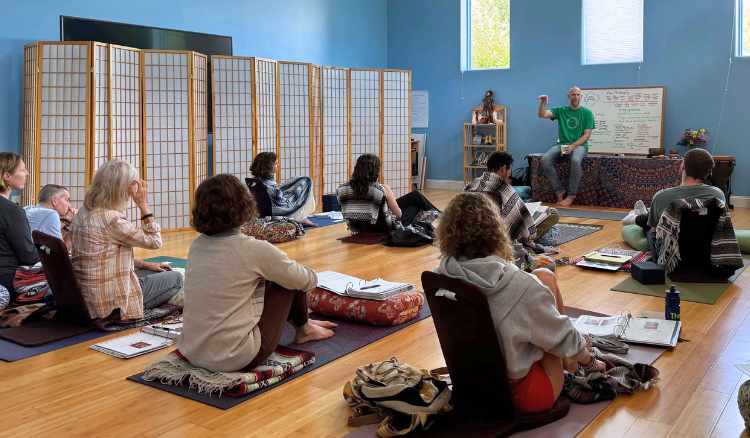
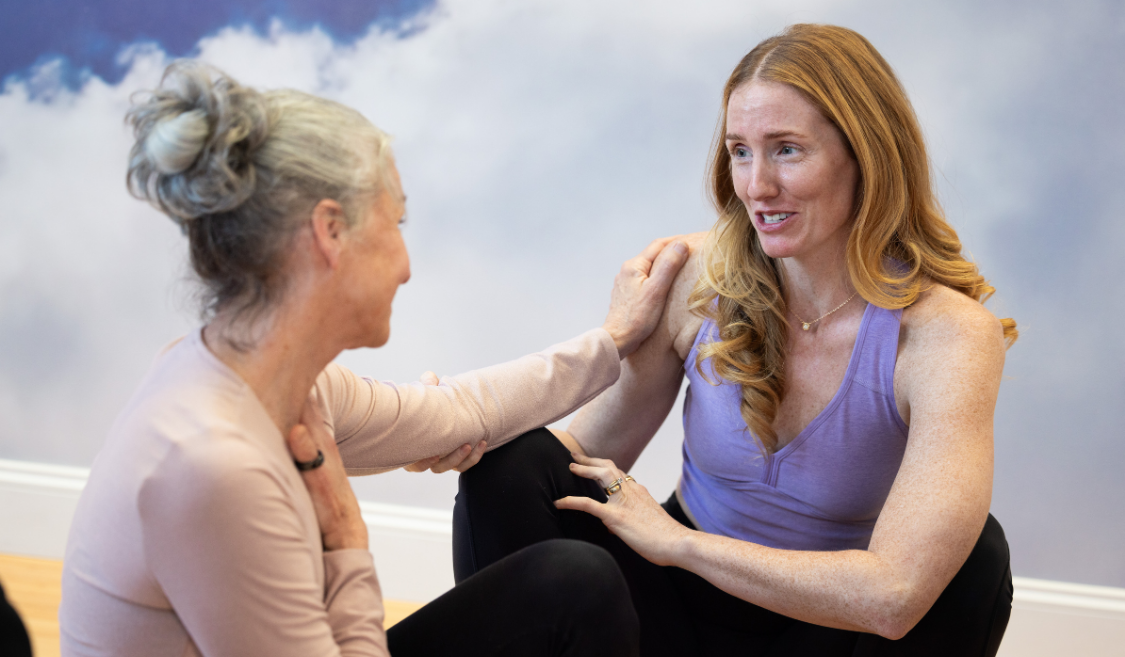
Not a lecture. Not an academic survey. A living practice of self-inquiry — read slowly, discussed openly, applied directly to the life you are actually living right now. We begin each session in meditation and prāṇāyāma, move into text and reflection, and close with journaling and shared inquiry. Week after week, we create a space to ask the questions the world rarely makes room for.
You don’t need to have read the Gītā before. You don’t need to start from the beginning. You simply need to be willing to look honestly at your own life — and to keep returning to the question Krishna never stops asking:
How do you engage and what is the source that moves you?
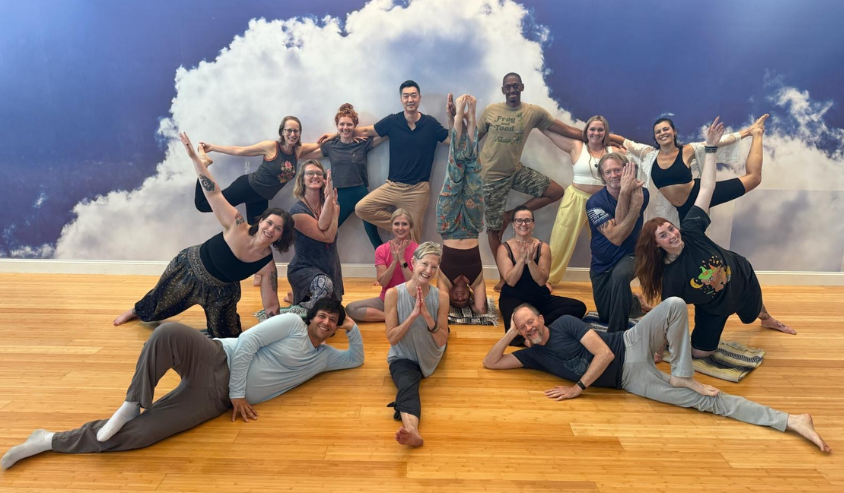
The next cycle begins September 16th at Asheville Yoga Center. This offering is open to the public and available for yoga teacher training continuing education credits.
I would love to have you there.
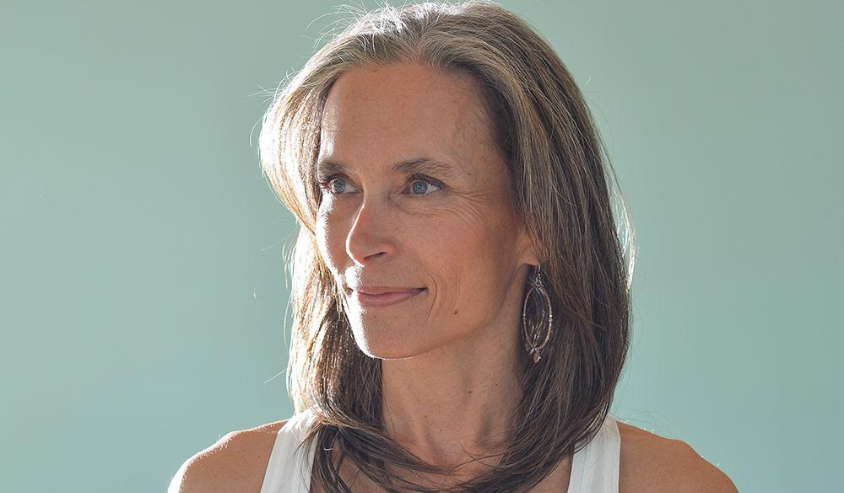
With love, Suzanne